The Economics of Trust: Why Choosing a School is Harder Than Buying a House
Feb 16, 2026
Why does choosing a school feel so much riskier than any other investment?
You are a sophisticated professional. You know how to evaluate a business deal, assess a stock or choose a luxury car. Yet, when it comes to selecting a school for your child, you likely feel a distinct, gnawing uncertainty.
Is this school really as good as its reputation? Will my child actually thrive here, or is the admissions tour just excellent marketing?
If you feel this way, you aren't being paranoid. You are reacting to a fundamental economic reality.
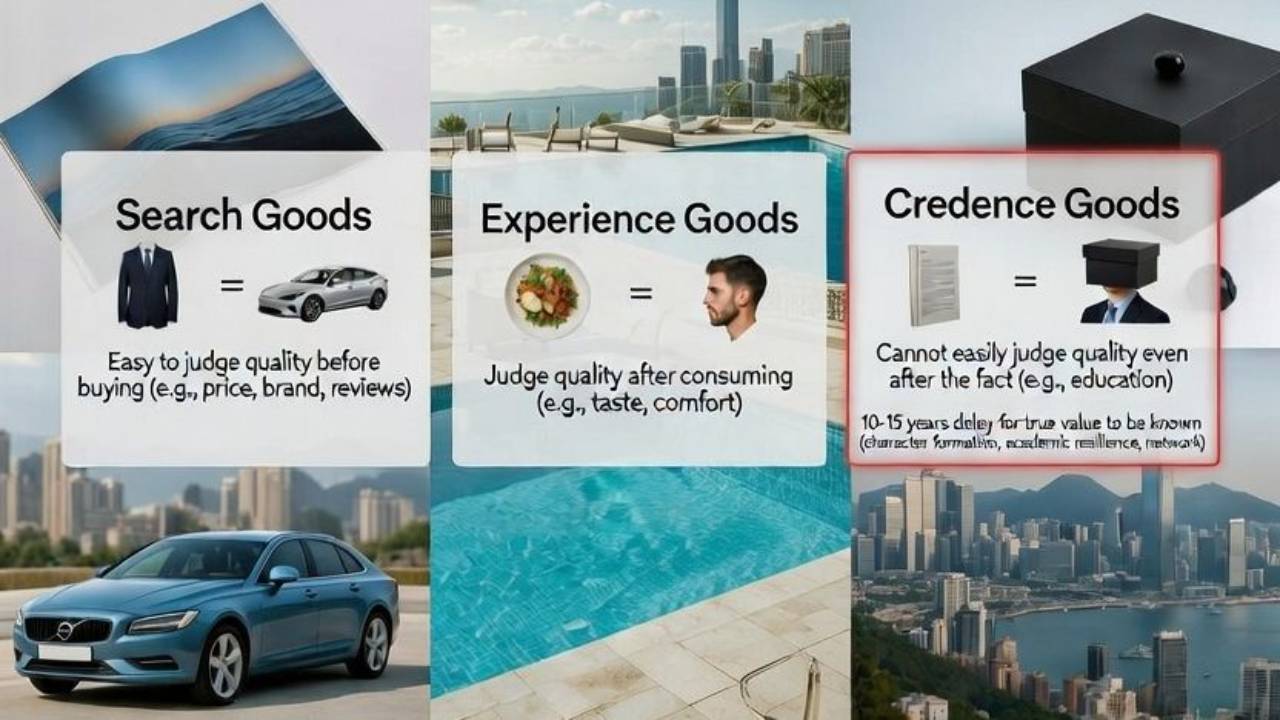
In economics, goods and services are classified by how easily a consumer can evaluate their quality. Understanding this classification explains exactly why school admissions are so stressful - and why the traditional "spray-and-pray" application method is fundamentally flawed.
The Three Types of Goods
To understand the school market, we must first look at how economists categorize value.
1. Search Goods (Easy to Judge)
These are items you can evaluate before you buy.
-
Example: A designer suit or a piece of fruit.
-
The Process: You touch the fabric, check the fit or look for bruises on the apple. You know exactly what you are getting before you hand over your credit card.
2. Experience Goods (Judge After Consumption)
These are things you can only evaluate after you have consumed them.
-
Example: A meal at a restaurant or a haircut.
-
The Process: You take a risk. If the steak is overcooked or the haircut is uneven, you know immediately. You can complain, write a bad review or simply never go back. The loss is minimal.
3. Credence Goods (Hard to Judge)
This is the most complex category. These are services where you cannot easily judge the quality even after you have consumed them.
-
Example: Surgery, legal services or Education.
-
The Process: You have to take it on faith (credence) that the service was necessary and performed well.
Why Education is the Ultimate "Credence Good"
Private education fits the Credence Good model perfectly and this creates a dangerous "Black Box" for parents.
The Time Lag
Unlike a haircut, you don’t know if a school education "worked" until years later. You pay the tuition today, but the "payout"- your child’s university placement, character development and critical thinking skills - won't be visible for some years to come - sometimes a decade or more.
By the time you realize a school wasn't the right fit, the window of opportunity has closed. The trajectory has already been set. You cannot "return" the product.
The Attribution Problem
If a student gets into Oxford or Harvard, was it because the school was excellent? Or was it because the child was naturally brilliant, the parents were supportive and they hired private tutors?
Conversely, if a child struggles, is it the school's fault or just a developmental phase?
Because it is nearly impossible to isolate the school's specific contribution, parents are often left guessing.
Information Asymmetry
The seller (the school) always knows more than the buyer (the parent). They know the reality of the classroom, the teacher turnover rates and the peer dynamics. You, the buyer, only see the polished admissions brochure and the swimming pool.
The Trap: Relying on "Signals" Instead of Strategy
Because parents cannot verify the quality of the education directly (the "Credence" problem), they subconsciously look for shortcuts. In economics, these are called Signals.
We look for:
-
High Fees: "If it costs this much, it must be good."
-
Heritage: "It’s been here for 100 years, so it must be safe."
-
Exclusive Waitlists: "If everyone else wants in, I should too."
While these signals can indicate quality, they are not guarantees. A school can have a 100-year history and a stunning campus but still fail to provide the pastoral care or academic nuance your specific child needs.
Buying based on signals is gambling. It is buying on faith.
How to Move From Faith to Facts
In a market of Credence Goods, trust is the only currency that matters.
However, blind trust is a strategy for failure. To navigate the admissions landscape successfully, you need to move from "Credence" (believing what you are told) to "Verification" (knowing what is true).
This is the core philosophy behind The Finding the Fit Formula.
As an expert intermediary, we bridge the gap between the marketing signals and the classroom reality. Because we have maintained relationships with admissions teams for so many years, we can see inside the "Black Box" in a way that parents cannot.
-
We verify the Inputs: We look past the facilities to understand the teaching ethos and the peer cohort.
-
We map the Trajectory: We don't just look at where the school is now; we look at where it places students in the future.
-
We reduce Asymmetry: We arm you with insider knowledge so you are not buying blind.
Conclusion: Secure the Trajectory
Don't leave your child’s education to credence. The cost of a mistake - not just financial, but developmental - is too high.
Relying on brand names and glossy brochures to tell you the story is risky. Let’s look at the data, the culture, and the reality. Let’s turn a blind purchase into a strategic investment.
Ready to stop guessing? Let's talk!
Get support today!
Request a no-obligation, friendly chat with a member of our expert team:
We hate SPAM. We will never sell your information, for any reason.
