Cracking the Admissions Code: How Local Families Can Outshine the Foreign Passport Advantage
Apr 28, 2026You walk out of an admissions assessment at a top-tier school like Canadian International School (CDNIS) or Hong Kong International School (HKIS), and you’re beaming. Your child was articulate, followed every instruction, and - crucially - didn’t have a meltdown. Meanwhile, another child in the group spent the entire hour sobbing into their Velcro shoes.
Naturally, you think: "We’ve got this in the bag."
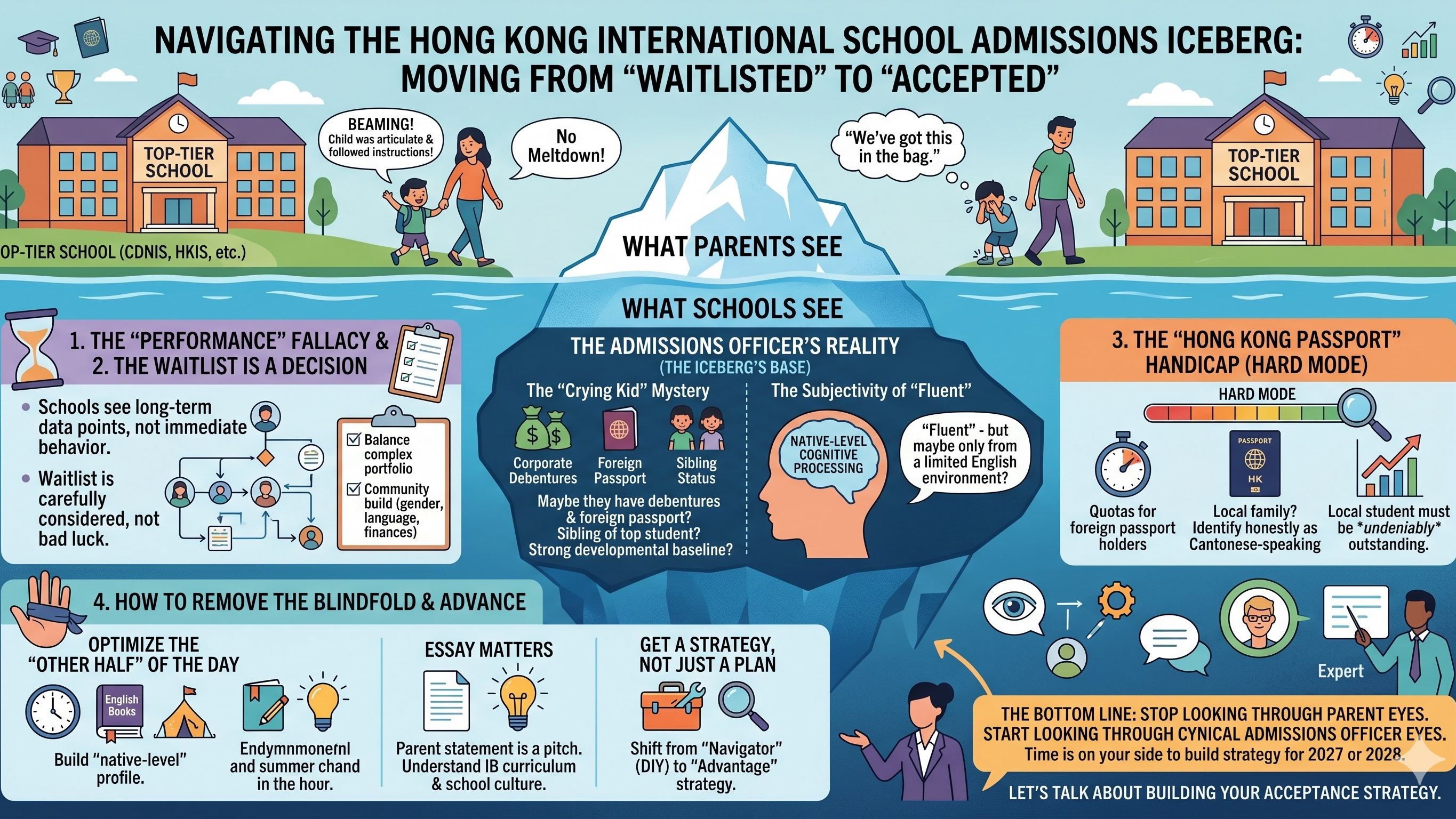
Then the email arrives. Waitlisted. And even more baffling? You find out the "crying kid" got an offer. It feels unfair, illogical, and frankly, like the school made a mistake. But here is the hard truth: You are the parent, but you are not the expert. In the high-stakes world of Hong Kong international school admissions, what you see as "performance" is often just the tip of the iceberg.
1. The "Performance" Fallacy
Parents often suffer from a specific type of blindness. You see your child’s immediate behaviour; the school sees a long-term data point.
-
The "Crying Kid" Mystery: Why did the child who cried get in? Maybe they have a corporate debenture AND a foreign passport. Maybe they are a sibling of a top-tier student. Or maybe, despite the tears, their developmental baseline (as evidenced by school reports or teacher reference) was off the charts.
-
The Subjectivity of "Fluent": You might think your child is "very fluent" in English. But admissions officers aren't just looking for "fluent". They are looking for native-level cognitive processing. If your child is from a Chinese speaking home and spends half a day a week in an English medium preschool, their English still may fall short of 'native'.
2. The Waitlist is a Decision, Not a Delay
When a school puts you on a waitlist, they have carefully considered your child against their selection criteria.
The Reality Check: Schools are balancing a complex portfolio. They aren't just picking the "smartest" kids; they are building a community. They need a specific mix of gender, language backgrounds, and - yes - financial commitments (debentures).
If you’re on the waitlist, it’s not because of "bad luck." It’s because, in that specific cycle, someone else checked more boxes than you did.
3. The "Hong Kong Passport" Handicap
If your child is a Hong Kong passport holder, you are playing the game on "Hard Mode." That is the reality in 2026, at its most acute than I have seen over the last 15 years.
-
The Identity Crisis: Many local parents list English as their child’s first language to gain an edge. Don't. Schools see through this instantly. If you are a local family, identifying as a Cantonese first-language speaker is often the more honest - and strategically sound - path.
-
The "Outstanding" Bar: Because international schools have quotas for foreign passport holders, a local student has to be significantly more outstanding than the child sitting next to them with a Canadian or British passport. Your child doesn't just have to be "as good"; they have to be undeniable.
4. How to Remove the Blindfold
So, how do you move from "Waitlisted" to "Accepted" for the next cycle? It starts with a strategy shift:
-
Optimize the "Other Half" of the Day: If your child is at a local or trilingual nursery in the afternoon, what are they doing in the other half of the day? Every activity, every summer camp, and every interaction needs to be geared toward building that "native-level" English profile as well as fitting in with a Western approach to parenting and education.
-
The Essay Matters: Your parent statement isn't just a bio; it’s a pitch. It needs to reflect a deep understanding of the IB curriculum and how your child fits that specific school's culture.
-
Get a Strategy, Not Just a Plan: If you want to actually move the needle, you need an "Advantage" strategy - someone to advocate for you, talk to the schools, and tell you the things your friends are too polite to say.
The Bottom Line
Your child is wonderful - but in the admissions room, they are one of a thousand wonderful children. To cut through the noise, you have to stop looking through the eyes of a proud parent and start looking through the eyes of a cynical admissions officer.
Time is on your side, but only if you use it to fix the gaps you currently can't see.
Looking to optimize your child's 2027 or 2028 application? Let's talk about building a strategy that goes beyond the assessment room. Complete the form below.
Get support today!
Request a no-obligation, friendly chat with a member of our expert team:
We hate SPAM. We will never sell your information, for any reason.
