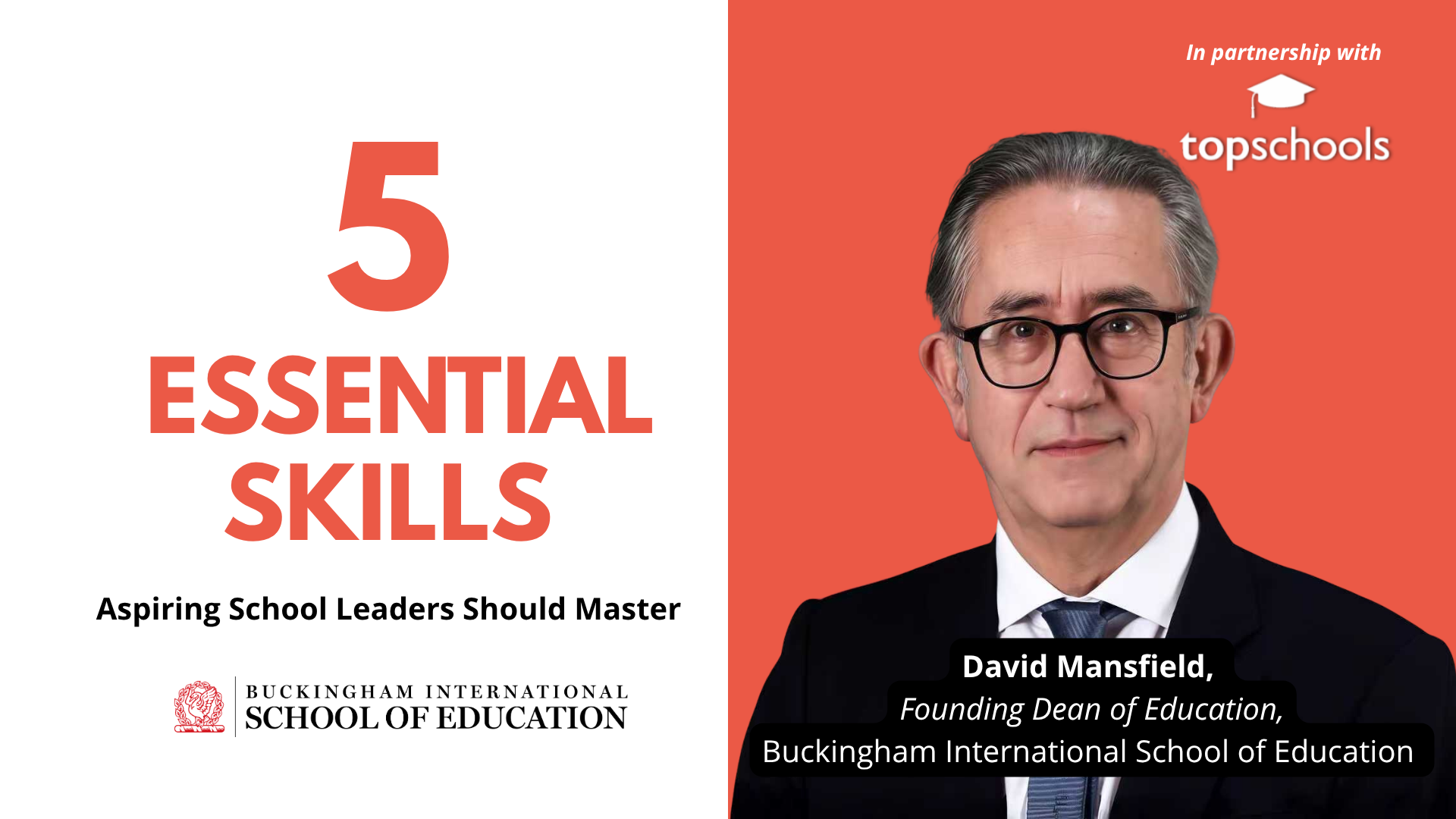
5 Essential Skills that Aspiring School Leaders Should Master
Apr 16, 2026Top Schools peppered David Mansfield... with questions regarding the essential skills aspiring school leaders must master. This blog post has been formatted according to his response.
Within a school, leaders need to respond to ever shifting contexts. Effective leadership means correctly applying your KNOWLEDGE, EXPERIENCE and COMMON SENSE to real, and often challenging, situations.
KNOWLEDGE - I supported my career development through study. Over the first 15 year of my career, I took several key postgraduate courses, including a PGCE, a Master’s in Education and even an MBA. One of the biggest, long-term benefits of postgraduate academic study is that it develops disciplined reflection. Writing assignments, engaging with research, and completing a dissertation trains a leader to think deeply about the evidence in front of them.
EXPERIENCE – Leadership skills must be deliberately developed over time and being mindful of them as they begin to emerge within your professional repertoire will accelerate their growth and embeddedness. The five top tips for aspiring school leaders that I present below are the result of my attempts to apply my own knowledge and common sense over the course of 30+ years in senior leadership positions in schools.
Running schools and securing the future of young people is the most wonderful task a human being can be given. I hope these top tips support your journey.
- How to make decisions in real, messy situations
Leadership courses will tell you that effective decision-making requires a consultative approach as opposed to an overly consensual or authoritarian one. However, many get unseated by what a consultative approach means in practice. This is what I have found:
- Patience is a virtue when building a mature team: It takes time to create a culture where people work together. A consensus-building approach may be a necessary strategy to build trust in the first instance. On occasion, direct instruction to the team may be essential to assert your own authority. Take the time to ensure your team is working well and mutual respect and support for one another is present. The consultative approach, where a leader can hear all points of view and then make a decision, will evolve.
- Compromise with intent: Working internationally, where there are often cultural differences and rival power centres within the organisation, requires a good leader to accommodate. However, accommodation or compromise needs to happen with intent. Be prepared to hear the evidence. I can count on one hand the number of times my first opinion on a subject became the eventual policy. ‘I don't want to be right, but I do want IT to be right’ should be every leader's mantra.
- Take a few tours around the mountain: New leaders very often see decision-making as an altar on which to make a stand. This tool is sometimes necessary, but more often it is the crucible in which humility and personal growth happen. Decision-making is a time when different individuals assert their own views and display their authority. Often, the ‘issue’ becomes secondary to the power struggle. A good leader recognises this and allows the power struggle to play out – often taking a few tours around the mountain - eventually bringing the decision that is needed to the fore.
- How to actually improve teaching and learning as a leader
Every potential Head of Department that I've interviewed has told me that they will prioritise teaching and learning. Moving the dial on the quality of what happens in the classroom is often a school leader’s most difficult task.
A mid-level leader in a school is responsible for ensuring that the children studying in their area get at least a good quality of delivery in all the key aspects of school life: teaching, learning, assessment, pastoral care and opportunities for growth. To make this happen, leaders must be intentional in every aspect of their work. Here’s a breakdown:
- Ensure a good, unitised curriculum is available with outline lesson plans, resourcing and effective guidance on formative as well as summative assessment.
- Every departmental meeting and professional learning opportunity needs to focus on not just the theory of good teaching but the actual practice of how that particular unit of work will be delivered in the most effective way.
- Accepted protocols for classroom management and basic processes of teaching and learning need to be agreed and then thoroughly applied.
- Mid-level leader walkthroughs and observations need to be regular and focused on aspects of the agreed standards and approaches that all staff in the team will be using.
- Peer support and mentoring must be available for and focused on those falling short.
- Student progress must be carefully tracked and data use to support decision-making on any intervention needed across the department.
- Where teachers are not delivering the agreed standard, action must be taken quickly.
This is no easy task. Successful leadership in schools is best done by those who are effective teachers. Leadership is not an escape from focusing on top quality teaching. With that in mind, my top tip #2 for aspiring school leaders is to develop your own teaching practice and be clear on how to improve the teaching practice of others.
- How to find the courage to challenge in difficult conversations
Brian Tracy popularised the phrase ‘eat that frog’ to mean stop procrastinating. He took the idea from Mark Twain, who once said that if you eat a live frog every morning, you can be satisfied for the rest of the day knowing that that was probably the worst thing that would happen to you that day.
However, nobody likes eating frogs, so most frogs get away with a free ride. We have all at some stage failed to address an issue, often giving very elaborate reasons ‘why the time is not right’.
If an aspiring leader learns one skill that will be invaluable all their professional life, it’s this: one needs to have high expectations of staff in order to deliver the best possible outcomes for students. What does that mean in practice?
- Make it clear what’s expected: leaders need to clearly articulate the standards they expect from their staff.
- Collect your evidence: measure performance effectively. It’s very hard to raise issues without hard data on performance.
- Don’t let being nice get in the way of being kind: The nice keep everyone happy; the kind tell the truth because they want the best for everyone, especially the students.
- Book a time: have courage to get that conversation in the diary sooner rather than later.
Before the conversation takes place, remember that hard conversations come in many shapes and sizes – formal, informal, structured. Think about the nature of your upcoming conversation and work out your strategy to keep the conversation professional and constructive.
How to support staff wellbeing while still maintaining standards is one of the hardest parts of school leadership and often the least talked about. I would recommend drawing from organisational behaviour strategies, as well as utilising reflective learning and coaching.
- How to maintain excellence without losing your team
Change in schools is constant. As a leader, you will learn that buy-in from colleagues when implementing change is never guaranteed. The culture you build in your team or school will have an impact on how change is accepted and implemented by your team.
John Kotter, the Harvard Change guru, argues for clear vision, building a critical mass of aligned colleagues, and only picking issues where there is a clear mandate or urgency for change.
In my experience, leaders must deal with occasional resistance, fatigue, incompetence and sadly cynicism. So, I agree that having clear direction is essential. As is good stakeholder management. What does that mean?
- Vision: Daniel Goleman, the Emotional Intelligence guru, argues that leaders who set a high pace, driving the team to deliver through a ‘do what I tell you’ mentality, are the least successful in the long-term. This style can deliver short-term impact in a turnaround situation, but over time a visionary and coaching culture wins the day. Authoritative leaders show moral authority, setting a grand vision and allowing team members space to deliver that vision.
- Stakeholder Management: Finding a position of moral authority is key. Many new leaders will inevitably either go too soft (‘let’s all be mates’) – or too hard (too many pep-talks that deteriorate into critical demands). My advice is to remember birthdays and names of colleagues’ children. But never allow a comfy, ‘down the pub on a Friday afternoon’ culture to emerge as it makes addressing underperformance more difficult.
Aim to be a leader who is respected for their effort but also their humanity. When implementing change, holding a position of kind, thoughtful humanity will aid acceptance among colleagues.
But don’t expect to be lauded for making tough decisions. Respect will come but it takes time, and often it is after a hard call that self-doubt creeps in. New leaders need to learn to stay strong.
5. How to understand what is really going on
Leaders need to have a clear understanding of what is happening in their area of responsibility.
This requires gathering data.
There is nothing magical in collecting performance data. Here I am talking about attainment, effort, participation, achievement against norms, attendance, behaviour, observation and walkthrough findings, student surveys, stakeholder/focus group outcomes etc.
WHAT IS MAGICAL is a leader who knows how to:
- evaluate that data holistically,
- turn the numbers and opinions into specific students’ names with appropriate action and improvement strategies
- be able to do this across their whole area of responsibility.
The danger of having so much data in schools nowadays is that collecting it becomes our sole purpose, when using it is the only way of moving things forward.
So, my advice to new leaders is to start small with the data they can gather in their area of responsibility (student and parent feedback, opinions of other teachers), spend time reflecting on the data, learn how to use AI to collate summaries of data, and then use relevant data to shape future improvement.
As I said, one of the greatest benefits of a Master’s degree is learning how to critically evaluate the data.
---
David Mansfield has a career in education spanning 40+ years, with 30+ in senior leadership positions. He was Executive Headmaster of YK Pao School in Shanghai and Headmaster of Dulwich College Beijing, as well leading two ‘outstanding’ secondary schools in England. He now works on international education consultancy projects, driving excellence in educational outcomes, as well as lecturing for the University of Buckingham’s teacher training programmes and supporting the work of Buckingham International School of Education (www.bise.org).
Apply for the Buckingham International Masters Scholarship Today! All details here: www.topschoolsadmissions.com/scholarship
Get support today!
Request a no-obligation, friendly chat with a member of our expert team:
We hate SPAM. We will never sell your information, for any reason.
